0
Your Cart
0
Your Cart

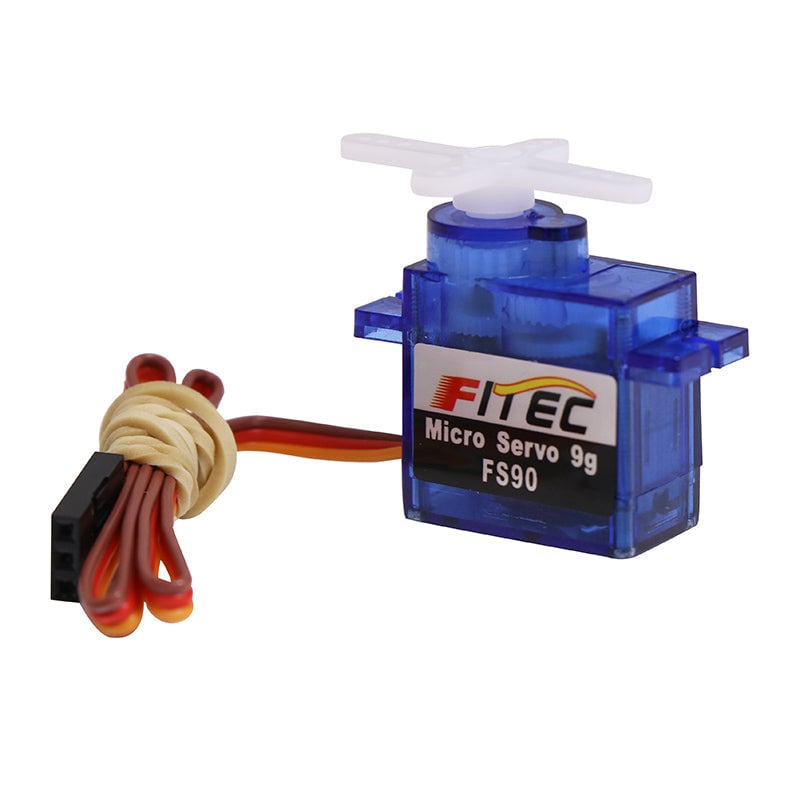
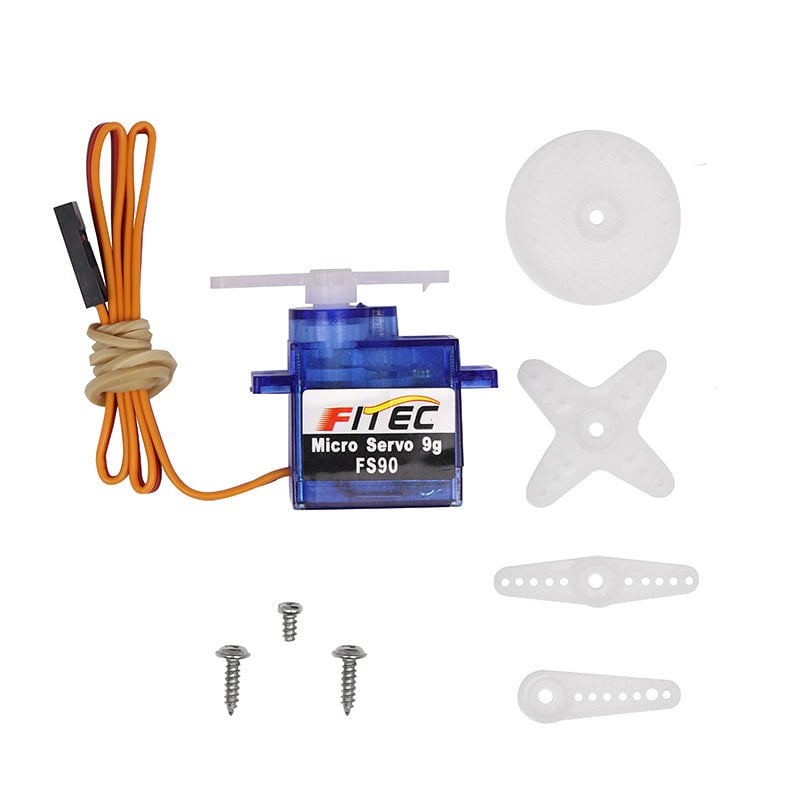
This Fitec Mini Servo is a great value multi-purpose micro size servo that is ideal for use with micro-controller systems like the BBC microbit, Arduino, Raspberry Pi and PICAXE. It’s miniature size also makes it great for use in radio controlled models.

This servo can rotate approximately 180 degrees, 90 in each direction and it comes with mounting screws and a range of horns to suit most applications. You can use any servo code, hardware or library to control these servos, so it’s great for beginners who want to make things move without the need for a motor driver board.

Note:

  • Although the stated operating voltage for this servo is outside of the the specs for the microbit, we use this servo with the microbit regularly with no issues.

Features:

  • Great value miniature Fitec servo.
  • Control horns included.
  • This servo has an operating voltage between 4.8V – 6V

Pin Assignments:

Contents:

  • 1 x Fitec Mini Servo.
  • 2 x Mounting screws.
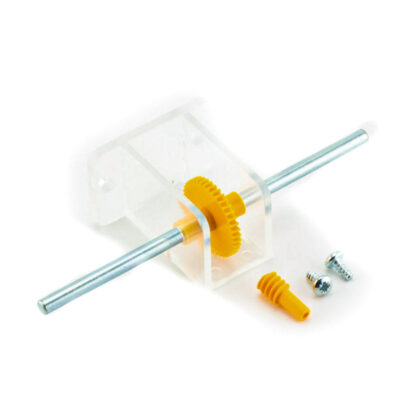
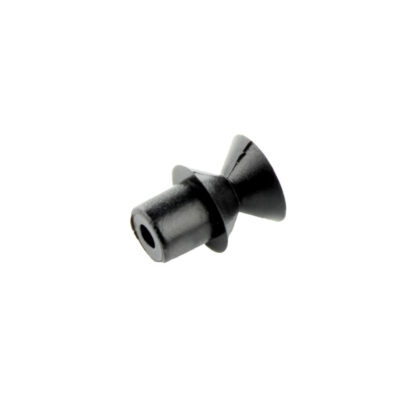
  • 3 x Control horns.

Dimensions:

  • Length: 23.2mm.
  • Width: 12.5mm
  • Height: 22mm

Technical Information

AttributeValue
Length 22mm.
Width 12mm.
Height 31mm.
Stall torque 1.8kg/cm (4.2V).
Operating speed 0.3s/60° (4.2V).
Operating voltage 4.8V-6V.
Temperature range 0° to 55°C.
Dead band width 10microseconds.
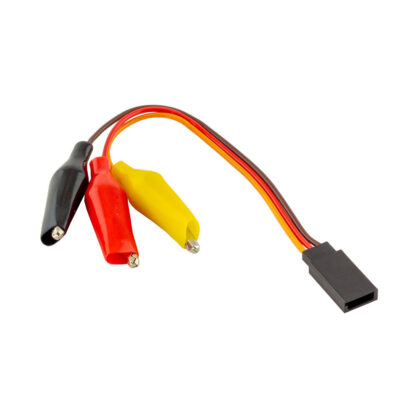
Red Wire Positive connection.
Brown Wire Ground connect

Related resources

1 review for Mini 180 Degree Resin Gear Servo FS90

  1. Ion

    Does It’s job.

Add a review

Your email address will not be published. Required fields are marked *

Questions and answers

    have you got a micro python class example. I've found some code on github that barely works
  1. 0 votes
    Q have you got a micro python class example. I've found some code on github that barely works
    Asked by Anonymous on July 31, 2018 12:00 am
    Answered by the admin Hi Phil, Without knowing what you are doing with the servo and what you are driving it with it is a little hard to provide resources for this. However if you are using our 16 Servo Driver board then you can use the microPython code on our Github page, https://github.com/KitronikLtd/pxt-kitronik-I2C-16-servo
  2. what's the current drain on the signal wire
  3. 0 votes
    Q what's the current drain on the signal wire
    Asked by Anonymous on July 24, 2018 12:00 am
    Answered by the admin Hi Phil, Max current draw on the signal line was 0.045mA, but it varied depending on the angle.
  4. What is the maximum voltage, and maximum current drain of this servo ?
  5. 0 votes
    Q What is the maximum voltage, and maximum current drain of this servo ?
    Asked by Anonymous on May 2, 2017 12:00 am
    Answered by the admin Hi Peter, The current drain on this servo is between 0.1-0.5A, and the voltage range is between 3-6V’s.
  6. What is the acceptable frequency range mark:space ratio for the PWM signal?I assume the PWM is rail-to-rail.
  7. 0 votes
    Q What is the acceptable frequency range mark:space ratio for the PWM signal?I assume the PWM is r...... Read more
    Asked by Anonymous on August 24, 2016 12:00 am
    Answered by the admin Hi Jon, the duty cycle is between 1-2ms. Position "0" (1.5 ms pulse) is middle, "90" (~1 ms pulse) is all the way to the left, 1.5ms pulse) is middle, "90" (~2 ms pulse) is all the way to the right, "180" (1 ms pulse) is all the way to the left. Power and signal are both 5V, PWM is rail to rail, PWM frequency is 50Hz (20ms period).
  8. How many of these can you connect directly to the BBC micro bit? Thanks
  9. 0 votes
    Q How many of these can you connect directly to the BBC micro bit? Thanks
    Asked by Anonymous on July 5, 2016 12:00 am
    Answered by the admin You can connect one servo directly to the BBC micro:bit, using the 0 and 3V pin on the micro:bit to power the servo. Alternatively you can connect three servos up to a secondary power supply and then connect the one servo to each output pin on the BBC micro:bit.
  10. Do you think this would be reasonably easy to control using / connecting to a 14 Genie Chip ? Thanks
  11. 0 votes
    Q Do you think this would be reasonably easy to control using / connecting to a 14 Genie Chip ? Th...... Read more
    Asked by Anonymous on June 22, 2016 12:00 am
    Answered by the admin Yes any micro-controller should be able to do it, you control the position by changing the ratio of time a pulse is high to the time it is low. I suspect there is a servo command or if not you want to use pulse width modulation.

    Unfortunately I’ve not got access to the Genie software so can’t advise on the specifics for that program.
  12. What is the torque rating of this servo ? (ie: how powerful is it ?)
  13. 0 votes
    Q What is the torque rating of this servo ? (ie: how powerful is it ?)
    Asked by Anonymous on June 20, 2016 12:00 am
    Answered by the admin The torque of the servo is 1.8KG/cm based on a power supply of 4.8V’s.
To submit a question, please login or create an account