Solar garden light kit

Products > Project kits > IC based kits > Solar garden light kit
Click image for larger image and to view more images if available.
Solar garden light kit

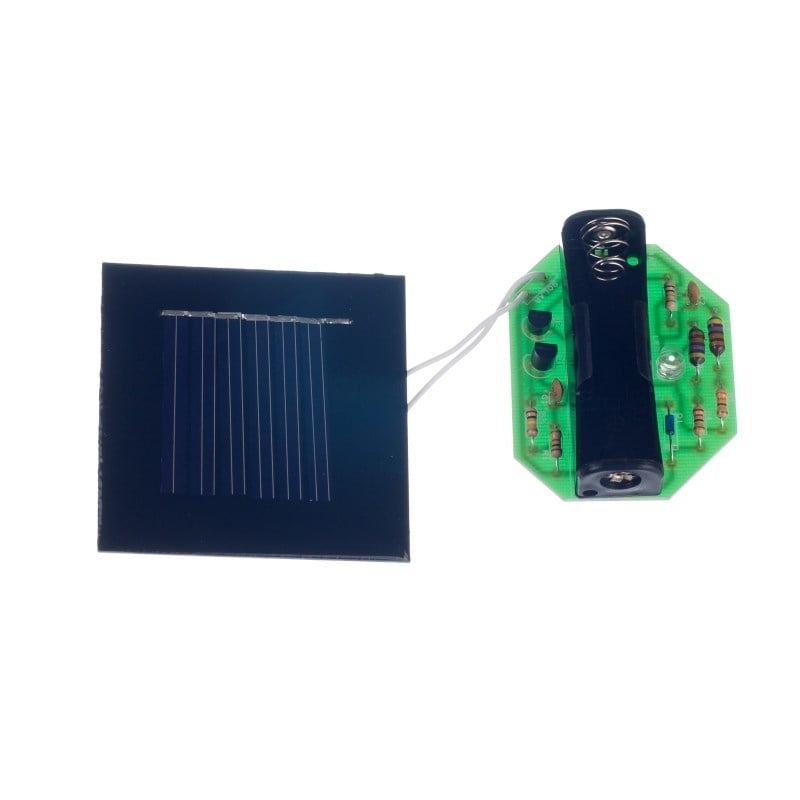
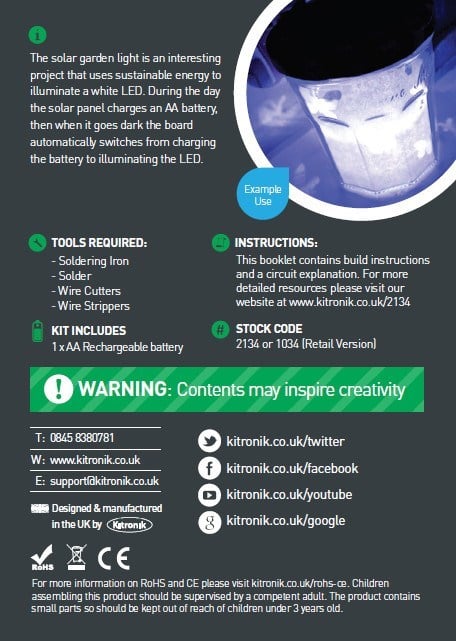
The solar garden light is an interesting project that uses sustainable energy to illuminate a white LED. During the day the solar panel charges an AA battery, then when it goes dark the board automatically switches from charging the battery to illuminating the LED.

The solar panel is resin encapsulated and therefore waterproof. Students will need to make a waterproof enclosure for the rest of the parts. Alternatively the sustainability theme can be extended to reusability as the board has been shaped so that it will fit into an old jar.

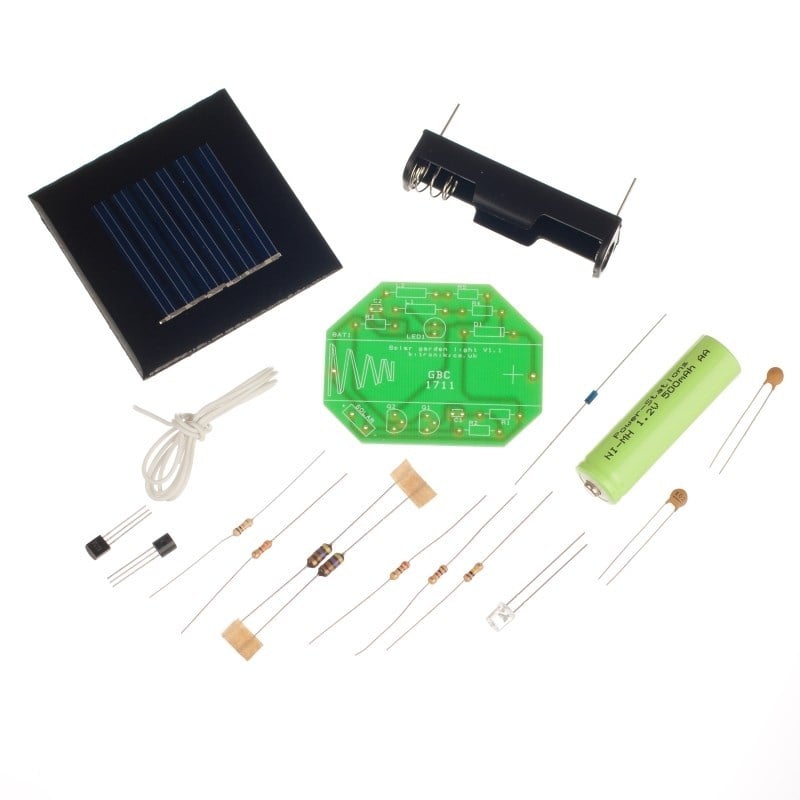
This kit includes:

  • 1 x solar cell (60mm by 60mm)
  • 1 x 500mAh rechargeable AA battery
  • 1 x 22ohm resistor
  • 1 x 330ohm resistor
  • 1 x 1Kohm resistor
  • 1 x 10Kohm resistor
  • 1 x 100Kohm resistor
  • 2 x 2nF capacitors, ceramic
  • 1 x Ultra bright wide view LED
  • 2 x BC337 transistors
  • 1 x AA battery holder, PCB mounting
  • 2 x 470uH inductors
  • 1 x BAT41 diode
  • 0.5m connecting wire (for solar cell)
  • 1 x solar garden light PCB

PCB dimensions: 44mm x 56mm.

Click here to download build instructions pdf_icon.gif

This product is also available in retail packaging making them an ideal gift. Click here to view the retail version

Note: Mouseover the price to see the Euro price.
DescriptionCode 1+ 10+ 100+ VAT
Solar garden light kit2134
£4.58
£5.50
£3.85
£4.62
£3.55
£4.26
ex VAT
inc VAT
*
  Current stock availability: 527

Ask a question about product:

Posted by julia sinclair on
Hi
I made your solar circuit but the light comes on when the sun is shinning on the solar panel not when it goes dark. What component recognises the dark or no light?
Your help would be appreciated as I hope to do this project after 1/2 term
Thanks Julia
Response by geoffhampson on
It is the voltage on the solar cell that determines if it is light or dark. In the teaching notes that were supplied with this kit is a fault finding flow chart. Assuming that the LED is always on and there is only one fault with the board then the problem will be fixed by checking:
R1 for dry joints.
R1 & R2 are in the right place.
C1 for a short.
The solar cell is in the right way around and for dry joints.
Q1 for dry joints or shorts.

If you are still struggling to get the board to work feel free to Email support at Kitronik.
Posted by phil on
Hello. I am hoping to incorporate the solar garden light kit into concrete garden ornaments that I make, but would like to have two led's ie for the eyes etc.

1. Is this possible
2. What would be the revised cost of the kit with the extra led
3. Could it be adapted to accept two of the colour changing led's and what would be the cost of that kit.

Thank you in advance

Phil
Response by geoffhampson on
The issue would be that the light has been designed so that the solar panel is matched to the LED, so that on all but a winter day the battery is charged by the same amount the LED uses. By adding a 2nd LED the battery would be discharged twice as fast. You could put the two LEDs in parallel off the same current limit resistor in which case it would take the same amount of current, however the LEDs would be dimmer.

Additional LEDs are available separately - enter 3546 in the search box (top right).

This kit runs off a single AA battery at 1.5V, but the LED has a forward voltage of 3V so wouldn't work directly off the battery, instead the kit works by driving the LED only for 50% of the time but at twice the voltage. This is done so fast that you can’t see that the LED isn't constantly on, but it would mean that if you connected a colour changing LED to the board it would keep resetting and never move off red.
Posted by Alan Rowse on
Hi Kitronik,
I am using this kit with some u/grad trainee teachers in conjunction with a sutainability project brief, do you know if it is possible to simulate the operation of the cct using Circuit Wizard? I have tried this but failed to get the correct operation. It may be a software limitation as the cct is fine and operates as described in the booklet.
Best wishes, Alan
Response by geoffhampson on
It wouldn’t surprise me that you are struggling to get the circuit to simulate. Both circuit wizard and crocodile clips have in my experience been poor at modelling circuits where the voltages are rapidly changing, which is the case in this circuit. I should however point out that when voltages change slowly the software simulates it very well.
Since this circuit runs off a 1.5V battery and the LED needs 3.5V the circuit switches the LED on and off many times a second. When the LED is off power is pumped in to the inductor, this is then used to increase the voltage feed in to the LED but for a shorter time. Because all this is happening very quickly and the software models it sampling the voltages at a slower rate it doesn’t simulate. Unfortunately I don’t have the software to try this, however I suspect if you change some of the component values it might well simulate. I would try changing C2 from a 1nF to a 1uF capacitor. If that doesn’t work try changing L1, L2 or R3.
Posted by Ian Boulton on
I want to fit the solar panel into a recess which has a dia of 71mm. Can I simply trim the corners of the panel?
Otherwise can I use 4 mini cells wired together which fit ok and give the same voltage and wattage?
Response by geoffhampson on
The active section of the cell is the part in the middle, with the silver lines, there is a section around the edge which is not electrically part of the solar cell. So yes, as long as you are careful it would be possible to remove the corners on the solar cell.
Posted by ben on
Hi. I have this kit and I would like to collect the power from 5 solar cells and I want to know if I can store the power to use it when I need it with for example switch. Thank you very much.
Response by geoffhampson on
You could parallel up 5 solar cells and use them with something else. However most of the circuit is involved in switching the LEDs on and off. All you need to charge the battery is a diode to stop the current flowing back in to the solar cell at night. I suspect you might be better buy solar cells on their own. You have miss typed you Email address if you Email support I can give you more info.
Leave a Reply


(Your email will not be publicly displayed.)

Please type the letters and numbers shown in the image.
Captcha Code

Click the image to see another captcha.


Average Rating:

Reviews:

Leave a Review


(Your email will not be publicly displayed.)


Please type the letters and numbers shown in the image.
Captcha Code

Click the image to see another captcha.